

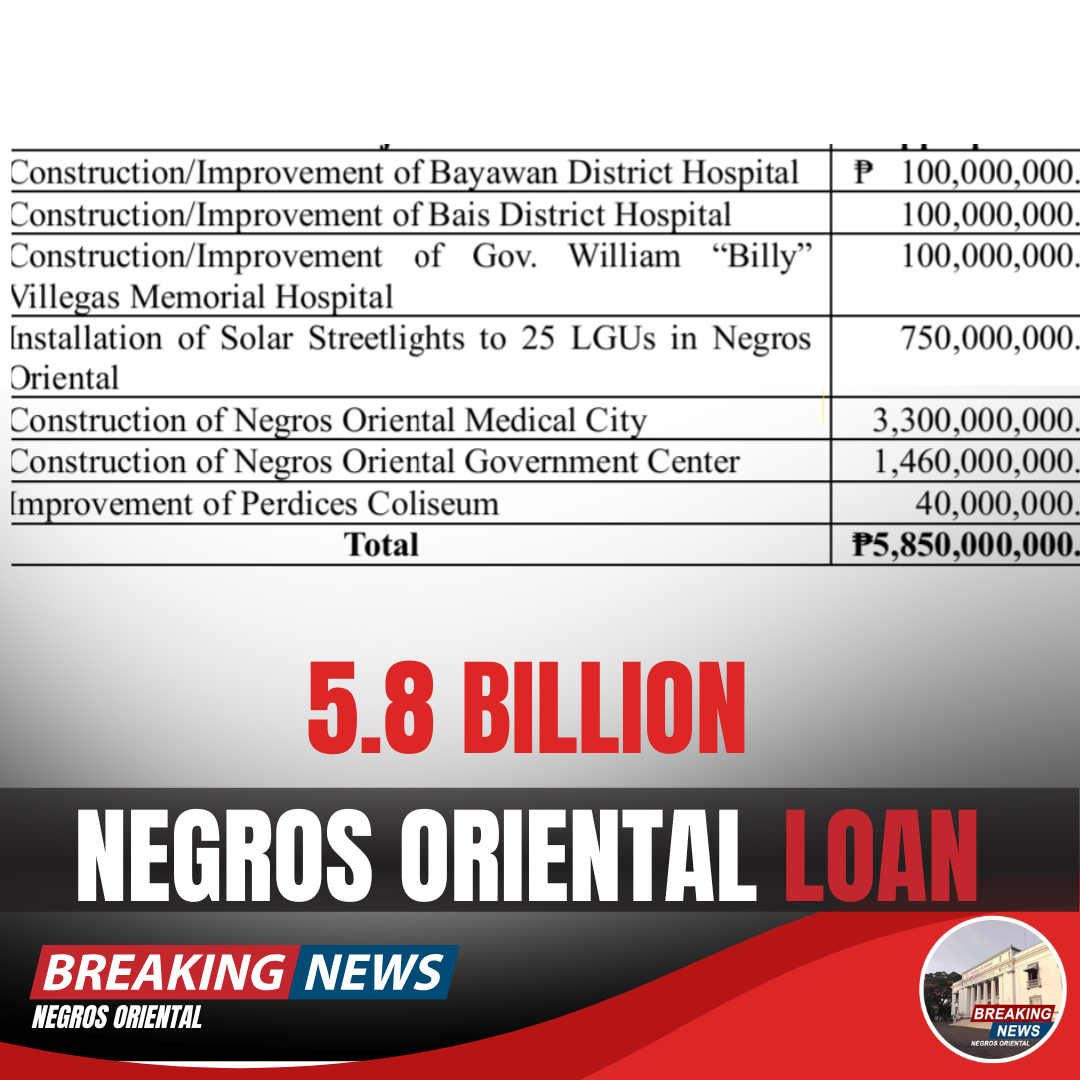
₱5.8B NEGROS ORIENTAL LOAN: THE CHORUS, THE LEDGER, AND REDEMPTION
There is a moment in every province when a decision becomes too large to be merely administrative. It stops being a line item and turns into a shadow that will outlive terms, personalities, slogans, and even the excuses of those who approved it.
That is what a ₱5.8-billion loan is: not just money, but time—years of repayment, years of narrowed choices, years of public services forced to compete with debt.
And when something that heavy is pushed forward, it rarely moves alone.
It travels with an escort: a chorus of reassurance, a convoy of friendly narratives, a parade of “explainers” meant to soften questions into background noise and convert scrutiny into inconvenience.
Because the fastest way to defeat public doubt is not to answer it—it is to embarrass it.
In Negros Oriental, the public was not only asked to accept a massive loan; it was asked to accept it as ordinary. As if the burden were merely a technicality. As if the proper questions were impolite. As if the province’s future could be signed away with casual confidence by those who will not be around when the bill comes due.
When we began questioning the viability of this loan—long before it was approved—the response was not engagement but hostility.
We were harassed.
We were attacked online.
We were vilified.
Trolls appeared. Paid media commentators took turns. Even voices presented as credible—writers, commentators, and members of the academe—joined the effort to discredit the questions rather than confront them. Scrutiny was framed as malice. Doubt was treated as sabotage. Asking for feasibility studies was portrayed as obstruction.
This was not debate.
It was intimidation by volume.
Yet the questions remained simple, legitimate, and unanswered.
This is how fast-tracking works in real life.
Not always through open coercion, but through shaping the public atmosphere—where speed is mistaken for competence, and questioning is portrayed as hostility.
But audits do not operate on atmosphere.
They operate on documents, compliance, and evidence.
They are the ledger that refuses to be hypnotized by applause.
And now, that ledger has spoken.
The Commission on Audit has laid bare the gap between what was sold to the public and what was secured on paper. Between assurances and safeguards. Between confidence and due diligence.
This report did not invent the concerns.
It validated them.
It confirmed what had been raised, warned about, and dismissed months earlier.
We did our part.
We asked early.
We asked publicly.
We asked responsibly.
What followed was vilification.
What arrived later was vindication.
If a loan of this magnitude truly deserved the public’s trust, it would not have needed a media escort. It would have stood on complete feasibility studies, transparent deliberations, and a paper trail sturdy enough to withstand the harshest reading.
Instead, scrutiny was treated as betrayal, watchdogs cast as adversaries, criticism personalized, and debate reduced to noise.
The messenger became the problem.
The question became the offense.
But the people are not attacking their province when they demand proof. They are defending it.
The more a decision relies on reassurance rather than records, the more it confesses its fear of the ledger.
And now the ledger has spoken.
So the questions remain, plain and unavoidable:
Who benefited from speed?
Who profited from silence?
Who mistook governance for loyalty?
And who will stand before the people when repayments begin to eat into services, projects, and dignity?
Because in the end, debt is not paid by those who approved it with confidence.
Debt is paid by the public—slowly, painfully, and without applause.
Negros Oriental deserves better than reassurance.
Negros Oriental deserves truth.
Negros Oriental deserves accountability.
Negros Oriental deserves redemption grounded in facts.
Negros Oriental COA report, Negros Oriental 5.8 billion loan, COA audit Negros Oriental, Negros Oriental loan controversy, Negros Oriental provincial board, Sangguniang Panlalawigan Negros Oriental, Negros Oriental public debt, Negros Oriental governance issues, provincial board accountability Philippines, local government loan Philippines, COA audit findings Philippines, Negros Oriental NTA 20 percent, Negros Oriental infrastructure loans, lack of feasibility study Philippines, cost benefit analysis government projects, public accountability Negros Oriental, government transparency Philippines, media harassment Philippines, silencing critics Philippines, paid media commentators Philippines, online harassment journalists Philippines, press freedom local media Philippines, academic voices in politics Philippines, whistleblower vindication Philippines, COA validates concerns, government debt transparency Philippines
